
Laser pulses capture unexplored polaronic states
24 June 2026
EurekAlert!: [https://www.eurekalert.org/news-releases/1133577]
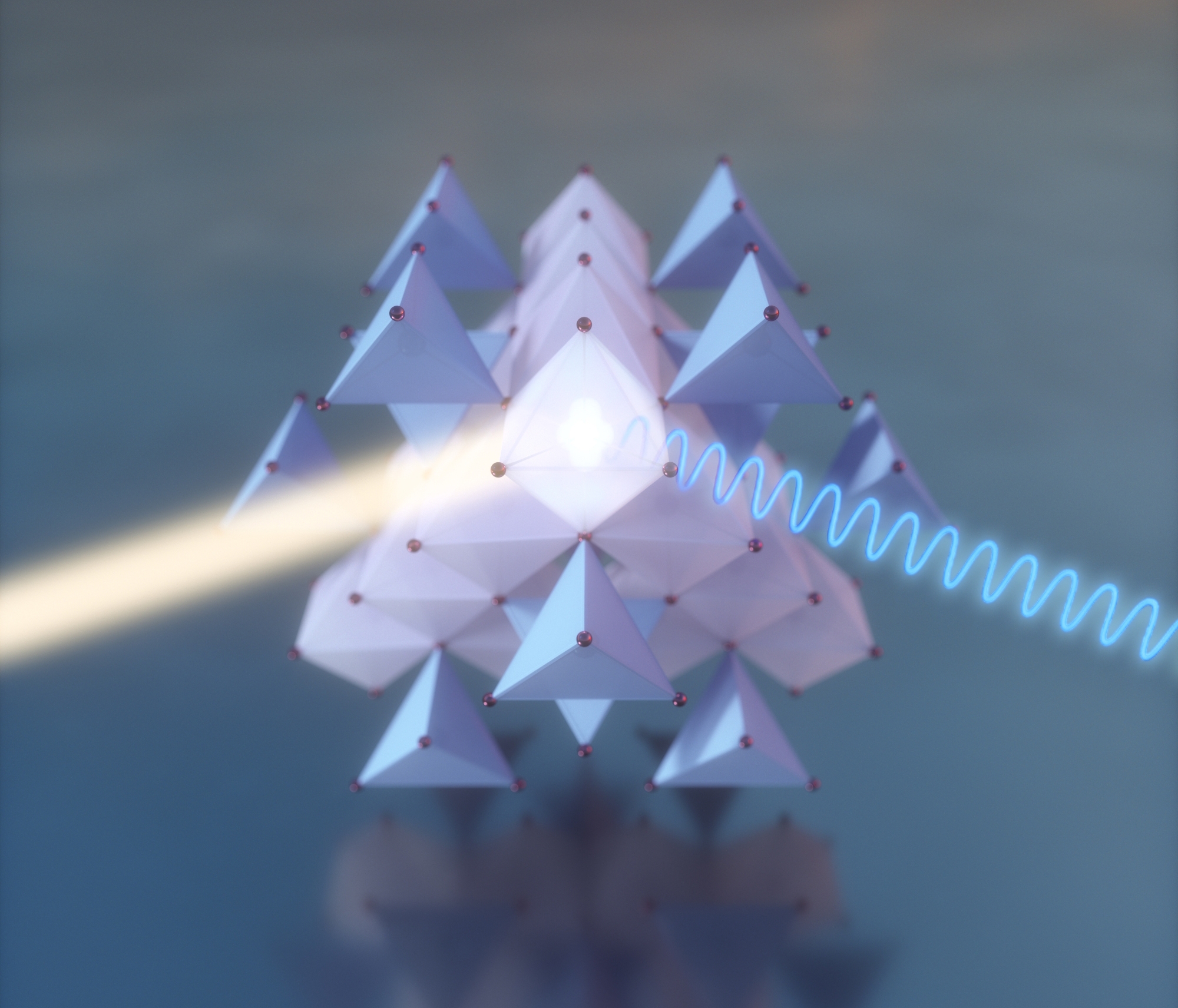
Laser-excited cobalt oxide, when probed with light of an appropriate energy (orange), emits radiation (blue) indicating the emergence of lattice vibrations in the crystal structure. The visualization depicts a unit cell with two distinct configurations of oxygen atoms surrounding the cobalt atoms. (Credit: Balázs Őrley)
In an international experiment, researchers observed Jahn–Teller polarons – quasiparticles that could play an important role in future ultrafast spintronic devices. These polarons emerged within the crystal lattice of cobalt oxide that had been activated by carefully tailored laser pulses.
When a cobalt oxide crystal is exposed to carefully tailored laser pulses, they induce specific local distortions of the crystal lattice that strongly affecting the material’s structural, electrical, and magnetic properties. The correlative experimental approaches that revealed these unexpected properties of cobalt oxide were carried out by a large international team of scientists from the University of Pavia (Italy), the Swiss Federal Institute of Technology Lausanne, the Paul Scherrer Institute (Switzerland), the University of Texas at Austin, the Massachusetts Institute of Technology, and Northeastern University (USA). The theoretical description of the phenomenon, which made it possible to uncover the nature of the observed oscillations, was developed by physicists from the Institute of Nuclear Physics of the Polish Academy of Sciences (IFJ PAN) in Cracow, with financial support from Poland’s National Science Centre.
Chemical catalysts, battery electrodes, photovoltaic cells and semiconductor gas sensors – these are just some of the modern applications of cobalt oxide (Co₃O₄). Despite its simple chemical formula, the unit cell of its crystal lattice consists of as many as 56 atoms: 24 cobalt and 32 oxygen. Depending on their position within the unit cell, the cobalt atoms exist here in two oxidation states. Of particular interest to physicists is the fact that where a cobalt ion is surrounded by four oxygen ions, it loses two electrons (and thus has an electric charge of +2), whereas when surrounded by six oxygen ions, it loses three (and its charge is then +3). This property means that cobalt oxide has a very rich electronic and magnetic structure, making it an interesting material for applications in spintronics, widely regarded as the successor to conventional electronics.
“At our institute, we had previously been modelling the physical properties of magnetite, the oldest magnetic material known to humankind. In terms of crystal structure, the studied cobalt oxide differs from magnetite only in that it contains cobalt atoms instead of iron atoms. We were therefore perfectly prepared for the task set before us by our experimental colleagues, which involved determining the nature of the coherent vibrations in the cobalt oxide crystal lattice that they had recorded,
” says Dr. Przemyslaw Piekarz, professor at the IFJ PAN.
To understand the essence of the discovery, described in the prestigious Journal of the American Chemical Society, it is necessary to explain the concepts of phonons. Just as a photon is a quantum of the electromagnetic field, so a phonon is a quantum of the vibrations of a crystal lattice. The phonon should therefore be understood as a vibrational wave capable of propagating through a material’s crystal lattice, characterised by a precisely defined wavelength and thus a specific energy.
In the reported experiments, a thin layer of cobalt oxide, just 27 nanometres thick, was first excited by a pump laser pulse and then probed by a second laser pulse after a controlled delay, with the experiment repeated many times while systematically varying the delay between the pump and probe pulses. The measurements were performed at two different pump-pulse energies, corresponding to red and blue light; both revealed markedly different behavior of cobalt oxide.
With red pump light, intensity oscillations appeared in the signal reflected from the sample; physicists at the IFJ PAN were able to unequivocally link these to the presence of the lowest-energy phonons allowed in cobalt oxide, specifically Raman-active phonons. Even more compelling were the coherent oscillations observed with blue pump light, since these are entirely absent in pristine cobalt oxide. Theoretical analysis uncovered the following sequence of events.
When a photon from the blue pump pulse hits the material, an electron can jump from an oxygen ion to a cobalt (3+) ion, which thereby becomes a cobalt (2+) ion. The crystal lattice responds immediately with a structural change around the cobalt ion, becoming asymmetric, with a dominant displacement of two out of six neighboring oxygen ions. This leads to an excess of electric charge and a characteristic lattice distortion, forming a polaron known as a Jahn-Teller polaron.
“From a practical perspective, this represents a form of local engineering of electronic and structural properties that can be obtained in a material using ultrafast laser pulses,
” states Prof. Piekarz.
The activation of Jahn-Teller polarons in cobalt oxide using laser light is made possible by the coupling between charge, spin, and structural properties within the material, which makes cobalt oxide a particularly attractive platform for future spintronics research. In the longer term, the discovery could contribute to the development of on-demand tailoring of functional responses in next generation logic and memory devices operating many times faster than today’s semiconductor electronic circuits.
[PDF]
Contact:
Prof. Przemysław Piekarz
Institute of Nuclear Physics, Polish Academy of Science
tel.: +48 12 662 8161
email: przemyslaw.piekarz@ifj.edu.pl
Scientific papers:
„Ultrafast Formation of Jahn–Teller Polarons Revealed by State-Selective Excitation in Correlated Spinel Co3O4”
S. Restelli, O. Cannelli, N. Colonna, C. Grova, P. Usai, M. Puppin, M. Mensi, F. Barantani, Y. Meng, J. Teyssier, M. Oppermann, F. Pennacchio, C. Bacellar, J. R. Rouxel, L. D. Leroy, O. Dogadov, N. Ohannessian, D. Pergolesi, P. Galinetto, P. Piekarz, A. Ptok, S. Chaudhary, G. A. Fiete, M. Chergui, E. Baldini, G. F. Mancini
Journal of the American Chemical Society, 2026, 148, 18, 18839-18848
DOI: 10.1021/jacs.5c23346
Images:
Laser-excited cobalt oxide, when probed with light of an appropriate energy (orange), emits radiation (blue) indicating the emergence of lattice vibrations in the crystal structure. The visualization depicts a unit cell with two distinct configurations of oxygen atoms surrounding the cobalt atoms. (Credit: Balázs Őrley)