
How long and sharp are the proton ‘needles’ used in radiotherapy treatments?
30 April 2026
EurekAlert!: [https://www.eurekalert.org/news-releases/1126585]
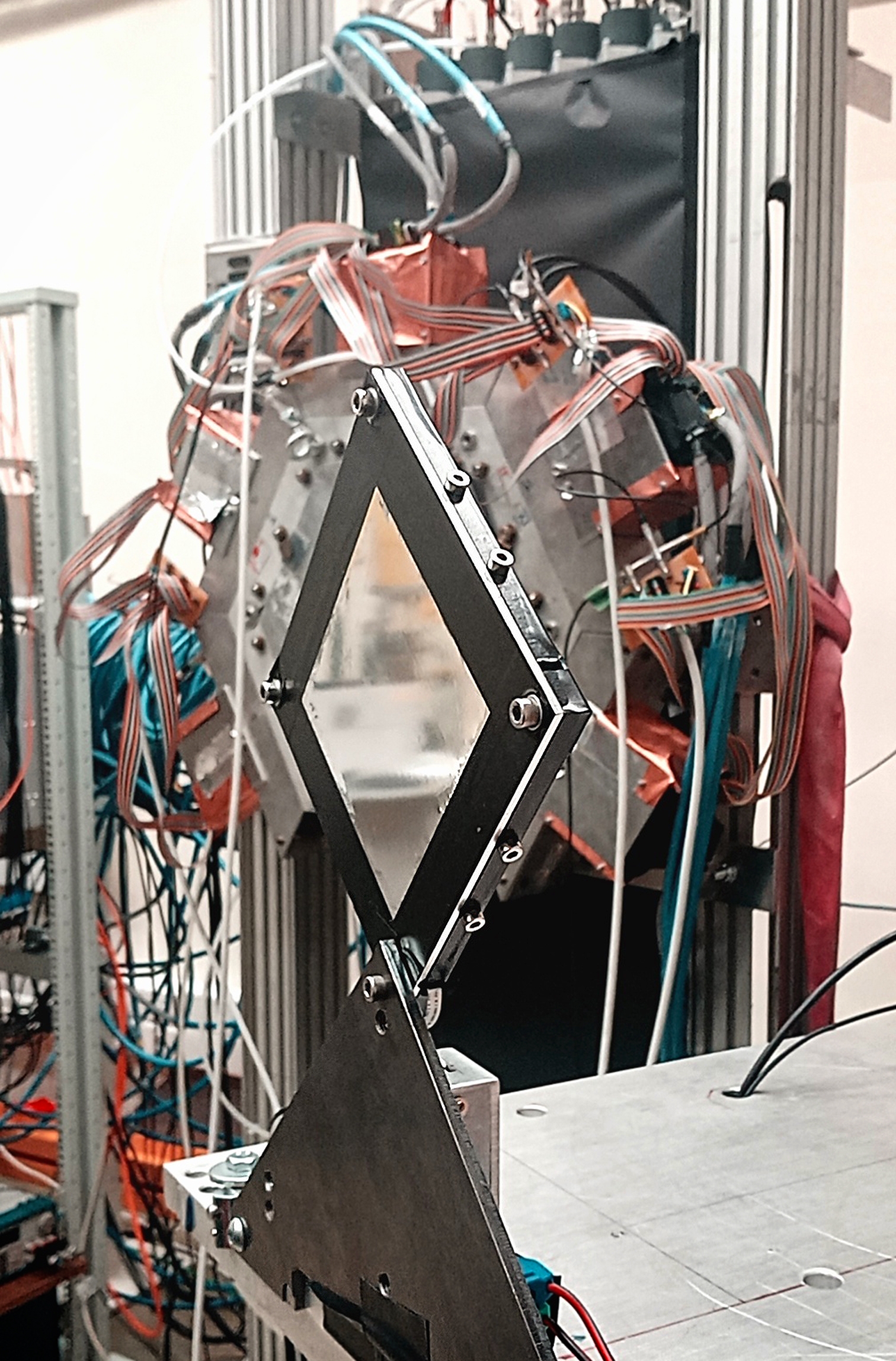
One of the two scintillation plates of the new instrument for measuring hadron beam kinetic energy. (Source: IFJ PAN)
Proton beams are not only used in sophisticated nuclear physics experiments. Today, they are becoming increasingly popular in radiotherapy, where they are an irreplaceable tool for destroying cancer cells. Doctors and physicists can enhance their precision thanks to two solutions developed at the Cyclotron Centre Bronowice of the Institute of Nuclear Physics, Polish Academy of Sciences.
In oncology, it is crucial to precisely eliminate cancer cells whilst causing as little damage as possible to healthy cells. For physicists, on the other hand, it is essential to have a precise understanding of the conditions under which they conduct their experiments. In the case of proton beams, used in radiotherapy and nuclear physics experiments, knowing the kinetic energy of the particles is key. At the Cyclotron Centre Bronowice (CCB), part of the Institute of Nuclear Physics, Polish Academy of Sciences (IFJ PAN) in Cracow, an innovative method for measuring this parameter has been developed, which is significantly simpler, faster and potentially more accurate than those used to date.
The main structural components of the measuring device presented by physicists from the IFJ PAN are two small scintillation plates, placed in the path of the proton beam at a known distance from one another (in the CCB experiments, the plates measured 9×9 cm and were separated by a distance of 3.6 metres). Scintillators are materials that react to the passage of a particle by emitting a flash of light. In theory, therefore, the matter is simple: one must record the flashes from the initial and final scintillators, determine their time difference, use this to calculate the particle’s velocity, and then its kinetic energy. In practice, however, problems arise.
„When we have a single proton that passes first through the initial detector and then through the final
one, the measurement is straightforward. However, we are working with a continuous beam,
consisting at any given moment of a large number of protons,
” says Dr. Wiktor Parol (IFJ PAN), the
lead author of the new measurement method. „It’s like measuring the speed of cars on a motorway
in sections. When there’s just one car, we simply measure the time it takes to travel from one toll
booth to the next – and that’s it. But imagine a multi-lane motorway jam-packed with cars of the
same make and colour, and we have to take a measurement from a distance, without being able to
see the number plates, the drivers or any other features that would allow us to distinguish the cars
from one another. How do we manage in this sort of situation?
”
Another transport analogy – that of the railway – can help to understand the solution described. Trains depart according to a certain timetable and travel the route at a fixed speed. Although they may arrive at their destination station with varying delays, one can expect them to arrive in a similar order to that in which they set off, whilst maintaining the pattern of time intervals between them.
The Cracow physicists therefore begin recording the sequence of signals on both scintillation detectors. Using their own mathematical methods, they filter out the noise, then restrict the sequence from the initial detector to a suitably chosen time interval and check after how long a similar sequence appeared on the final detector. The time shift of the sequence found in this way allows the average kinetic energy of the proton beam to be calculated, given the known distance between the detectors.
„For the beams used at our centre, just two milliseconds of data collection is enough to reduce the
statistical uncertainty of the measurement of the beam’s average kinetic energy to below 0.25 percent,
” stresses Dr. Parol.
With proton therapy in mind, tests of the kinetic energy of proton beams are carried out using certified water phantoms. The procedure requires replacing the treatment table with a technical table fitted with a phantom, which must be positioned correctly so that the range of the protons in water can then be measured. The entire measurement takes several dozen minutes and can usually be performed no more than once a day. In the solution proposed by the IFJ PAN, it is sufficient to briefly insert scintillators into the beam path (the interference with the accelerator infrastructure is therefore minimal) and collect several measurement sequences. Signal analysis depends on the computer’s processing power and, in the offline tests carried out, usually took no longer than a few to several dozen seconds. All this means that measurements of the proton beam’s kinetic energy could be carried out practically before every treatment, significantly improving its precision and safety.
The highly accurate determination of the average kinetic energy of protons in the beams is not the only piece of information that can be obtained using the method proposed by the Cracow physicists. Another important parameter of accelerator beams, the measurement of which has hitherto posed problems, is the spread of the beam’s kinetic energy. It is obvious that, since a beam consists of a large number of protons, there must be slight differences in their velocities, and therefore in their kinetic energy. And since it is the kinetic energy that determines the beam’s interaction with material in physics experiments or the depth at which protons deposit their energy in a patient’s body, knowledge of the beam’s kinetic energy spread allows us to determine how ‘sharp’ the proton ‘needle’ is.
„The ability to determine the kinetic energy spread of the protons emerged as a natural consequence
of the approach we adopted. The key insight here is that, since we have found a fragment
in the data from the final detector that corresponds to a sequence of pulses from the initial
detector, we can precisely determine which pulse from the initial detector corresponds to which
one in the final detector,
” explains Dr. Parol.
By knowing the transit times of individual protons, one can determine their individual kinetic energies – and this makes it possible to analyse the extent to which these energies differ from one another. In this way, the beam operator gains an understanding of the spatial spread of the proton energy deposition zone within the material being examined or within the patient’s body.
An important advantage of both methods described is their scalability. Both were developed at the Cyclotron Centre Bronowice, where protons with energies ranging from 60 to 200 megaelectronvolts are used in radiotherapy treatments and physics experiments. However, there is nothing to prevent the kinetic energies and their spread from being measured in more powerful accelerators as well, provided the detectors and the distances between them are skilfully selected; these accelerators accelerate particles to energies of an order of magnitude greater, measured in gigaelectronvolts.
The methods for measuring the average kinetic energy of hadron beams and their spread, which have already been patented, were developed with co-funding from the Polish National Science Centre.
[PDF]
Contact:
Dr. Wiktor Parol
Department of Nuclear Reactions and Hadronic Processes
Institute of Nuclear Physics, Polish Academy of Science
tel.: +48 12 662 8213
email: wiktor.parol@ifj.edu.pl
Patents:
„Method for determining the kinetic energy of a hadron beam”
Patent PL 249360
„Method for determining the kinetic energy dispersion of a hadron beam”
Patent PL 249361
W. Parol, P. Kulessa, A. Kozela
Images:
One of the two scintillation plates of the new instrument for measuring hadron beam kinetic energy. (Source: IFJ PAN)
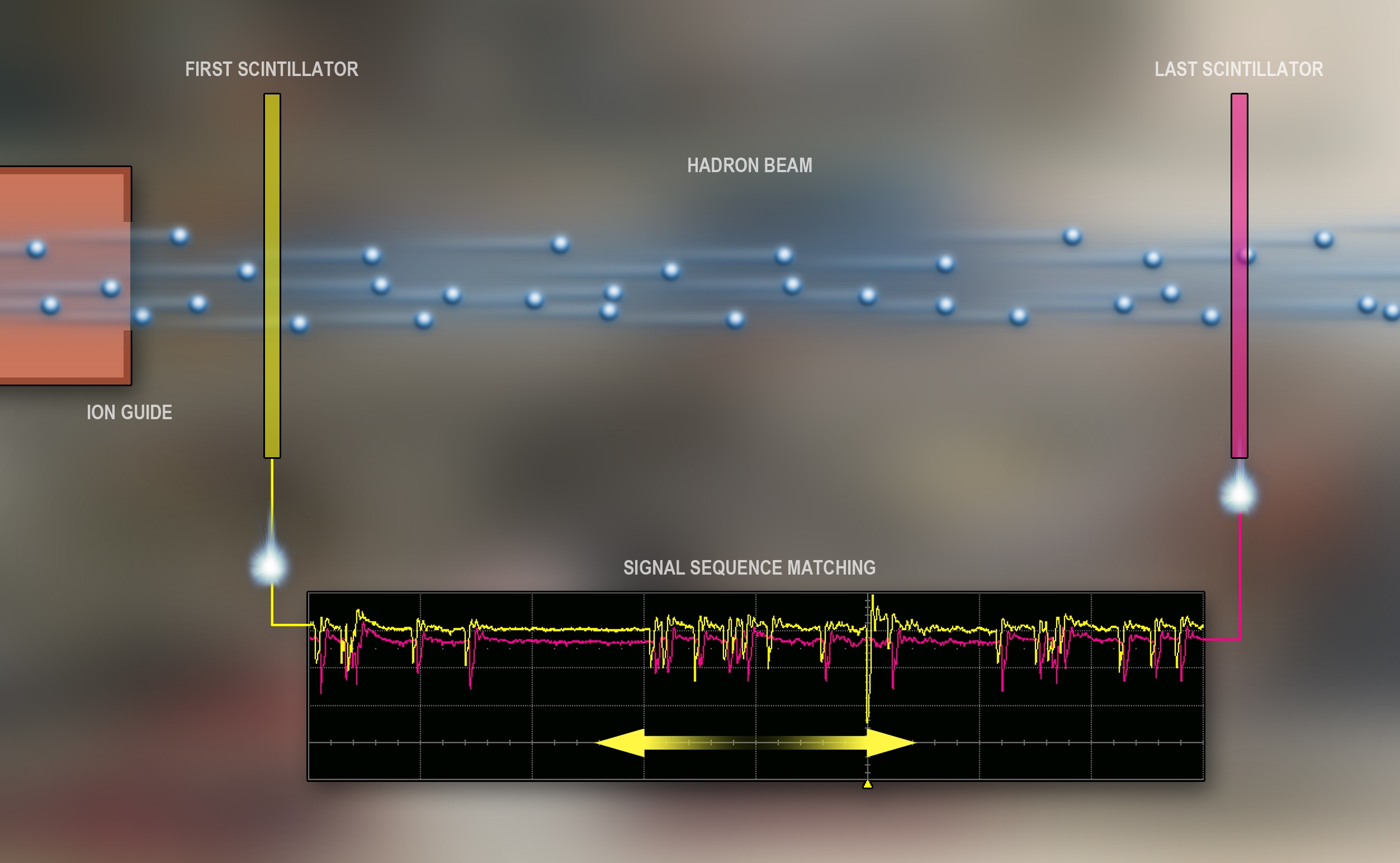
The main idea of the new hadron beam kinetic energy measurement is to record a sequence of signals in the initial detector and search for its counterpart in the sequence from the final detector. (Source: IFJ PAN)