
Better understanding of the unknown leads to more accurate collision simulations
5 March 2026
EurekAlert!: [https://www.eurekalert.org/news-releases/1118856]
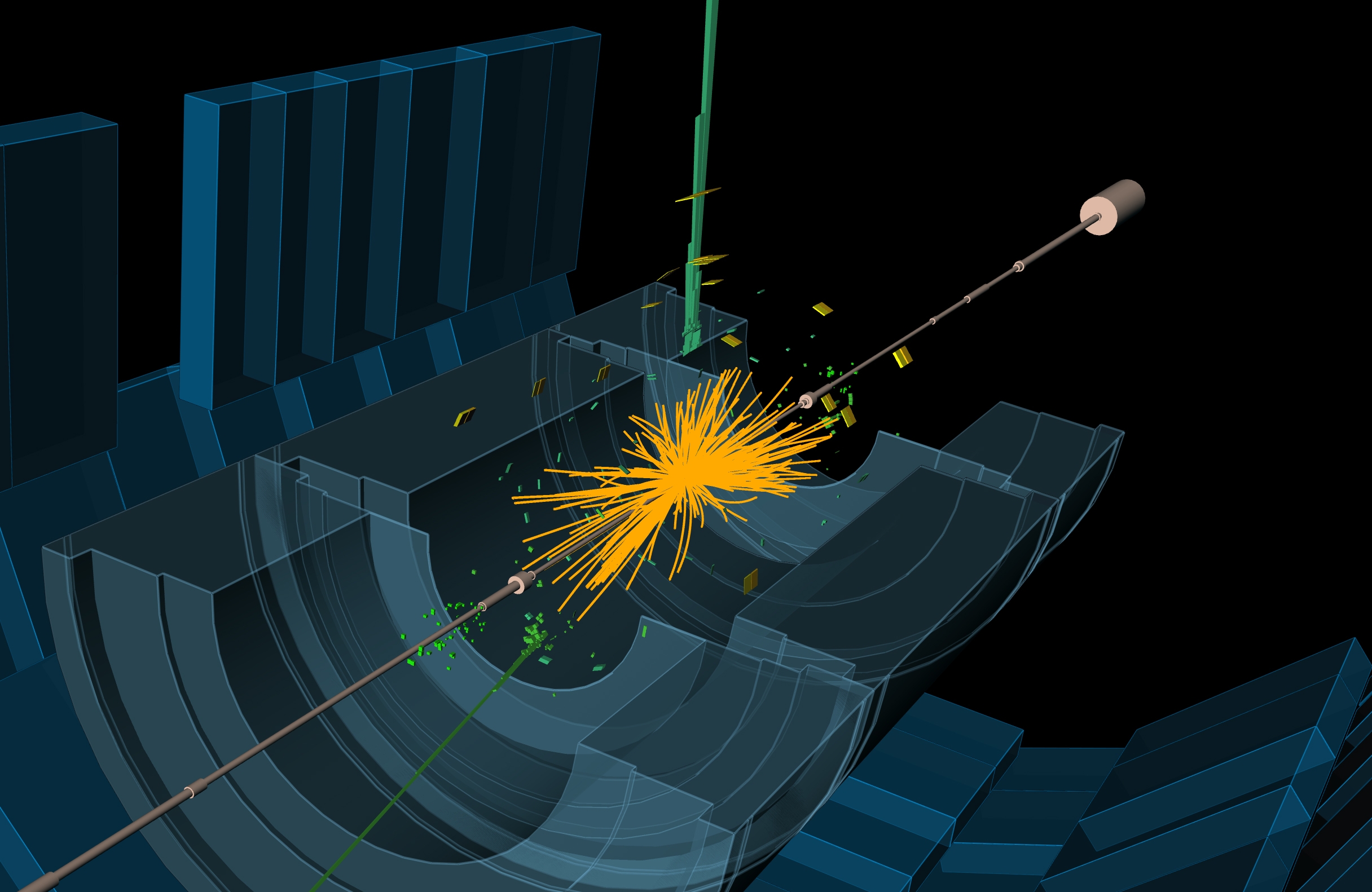
Improving the accuracy of particle collision interpretation can help uncover new physics phenomena. (Source: ATLAS Collaboration)
Estimating things that exist is generally easy, but when it comes to estimating things that do not exist, it’s more difficult. This is something physicists from Poland and the UK are well aware of. To improve current simulations of high-energy particle collisions, they have developed a more accurate method for estimating the impact of calculations that are... not performed.
Prediction can be difficult, especially when it comes to the future, as Niels Bohr – one of the fathers of quantum mechanics – once said. The fundamental problem with predicting the future lies in the simple fact that we just do not know it. A somewhat similar challenge arises in the calculations used to model high-energy particle collisions: for them to be useful, one must be able to estimate the impact of calculations that are not performed. Physicists Matthew A. Lim from the University of Sussex in Brighton and Dr. Rene Poncelet from the Institute of Nuclear Physics of the Polish Academy of Sciences (IFJ PAN) in Cracow have presented a new approach to this issue in the journal Physical Review D.
„Data from particle collisions collected by accelerators such as the LHC always require careful interpretation.
To understand what has been recorded, we need to compare the measurements with
the predictions of a theoretical model. However, due to the complexity of calculations in high-energy
physics, simulation results are never completely accurate. We have proposed a variant of
perturbative calculations that reduces the uncertainties present in previous simulations,
” says Dr.
Poncelet, who in 2025 received a prestigious European ERC Starting Grant to carry out a new,
highly precise computer simulation of high-energy particle collisions.
Astronomy provides a vivid explanation of the essence of the perturbative approach. The Earth's orbit around the Sun can only be calculated accurately if we assume that the influence of other bodies in the Solar System is negligible. But if we wanted to take into account how, for example, Jupiter affects this orbit, the gravitational equation can no longer be solved directly – this is the famous three-body problem. This is when the perturbative approach is used: the influence of another planet is not included in the main equation, but is introduced as a small factor that disturbs the solution of a simpler equation.
„In perturbation theory, instead of calculating complex functions directly, we approximate them using
series expansions. The first-order terms that appear here can be imagined as continents on
a map. Second-order corrections would correspond in this analogy to bays or islands off the coast,
while terms of even higher orders would map the location of individual rocks or stones, for example,
” explains Dr. Poncelet.
The perturbative approach works very well in many applications, from calculating the trajectories of rockets and interplanetary probes to strength analyses of load-bearing structures. However, when we want to use it to simulate particle collisions at the highest energies, especially when searching for new physics, significant problems immediately arise. In series expansions, corrections of each successive order require an increasing amount of computation, which in the case of such a nontrivial theory as quantum chromodynamics used at the time means an increasing number of complex integrations. The complexity of the calculations grows exponentially, and thus the time required to perform them increases dramatically.
Due to computational limitations, the process of expanding into a series is interrupted quite quickly in simulations of high-energy particle collisions. As a result, the calculated values differ slightly from the parameters measured in accelerator experiments. The key question is: by how much? The difference could be calculated quite easily if the series used in collision simulations were convergent; the problem is that generally they are not. So how can we estimate corrections when all we know is that we know nothing about them? And we cannot ignore them, because that is where new physics may exist!
The basic method for estimating uncalculated corrections is the scale variation method. Corrections of all orders depend on a parameter called the renormalization scale, which is arbitrarily chosen to be adequate for the energy of the modelled collisions. After completing the main calculations, which take into account the assumed number of corrections, this parameter is modified within an arbitrarily selected range to check how the changes affect the calculations and their consistency with the data. It is on this basis that the impact of corrections omitted from the calculations using the originally assumed renormalization scale can then be estimated.
In recent years, an alternative approach has gained popularity, consisting of modifying parameters referred to as nuisance parameters. Similar to scale variation, the influence of changes in selected parameters on the magnitude of calculated corrections is investigated here. However, it is not a single mathematical parameter (like renormalization scale) that is subject to change, but parameters that are much better interpreted physically. In the case of high-energy particle collision simulations, these could be, for example, particle masses, coupling constants, probability distribution function parameters, etc. The basic advantage here lies in the fact that changes in the values of appropriately selected nuisance parameters must retain their physical meaning and be consistent with previous measurements. In this approach, although estimating the unknown requires expert knowledge, it is subject to much less arbitrariness.
The published article proposes a new estimation methodology using nuisance parameters and shows that it is in excellent agreement with data collected at the Large Hadron Collider for ten types of high-energy proton collisions. The analysis included cases such as the production of the Higgs boson, pairs of W or Z bosons, pairs of real quarks with their antiquarks, and processes resulting in the formation of gamma quanta and hadron jets. Where the standard approach using scale variations worked well, the new approach led to similar results, while in previously problematic cases, the latest estimates proved to be more realistic.
„We have proposed a ready-to-use method for estimating unknown higher-order corrections in perturbative
calculations concerning high-energy proton collisions, which is physically better grounded
than the previous one. Improving the reliability of theoretical uncertainty estimates will allow for
more accurate interpretations of the phenomena occurring during particle collisions, both in the
Large Hadron Collider and in future accelerators,
” summarizes Dr. Poncelet.
The above research is part of the work covered by the ERC Starting Grant.
[PDF]
Contact:
Dr. Rene Poncelet
Institute of Nuclear Physics, Polish Academy of Sciences
email: rene.poncelet@ifj.edu.pl
Scientific papers:
„Robust estimates of theoretical uncertainties at fixed-order in perturbation theory”
M. A. Lim, R. Poncelet
Physical Review D 112, L111901, 2025
DOI: 10.1103/7g5k-4y3v
Images:
Improving the accuracy of particle collision interpretation can help uncover new physics phenomena. (Source: ATLAS Collaboration)