
LHC data confirm validity of a new model of hadron production – and test the foundations of quantum mechanics
3 December 2025
EurekAlert!: [https://www.eurekalert.org/news-releases/1108491]
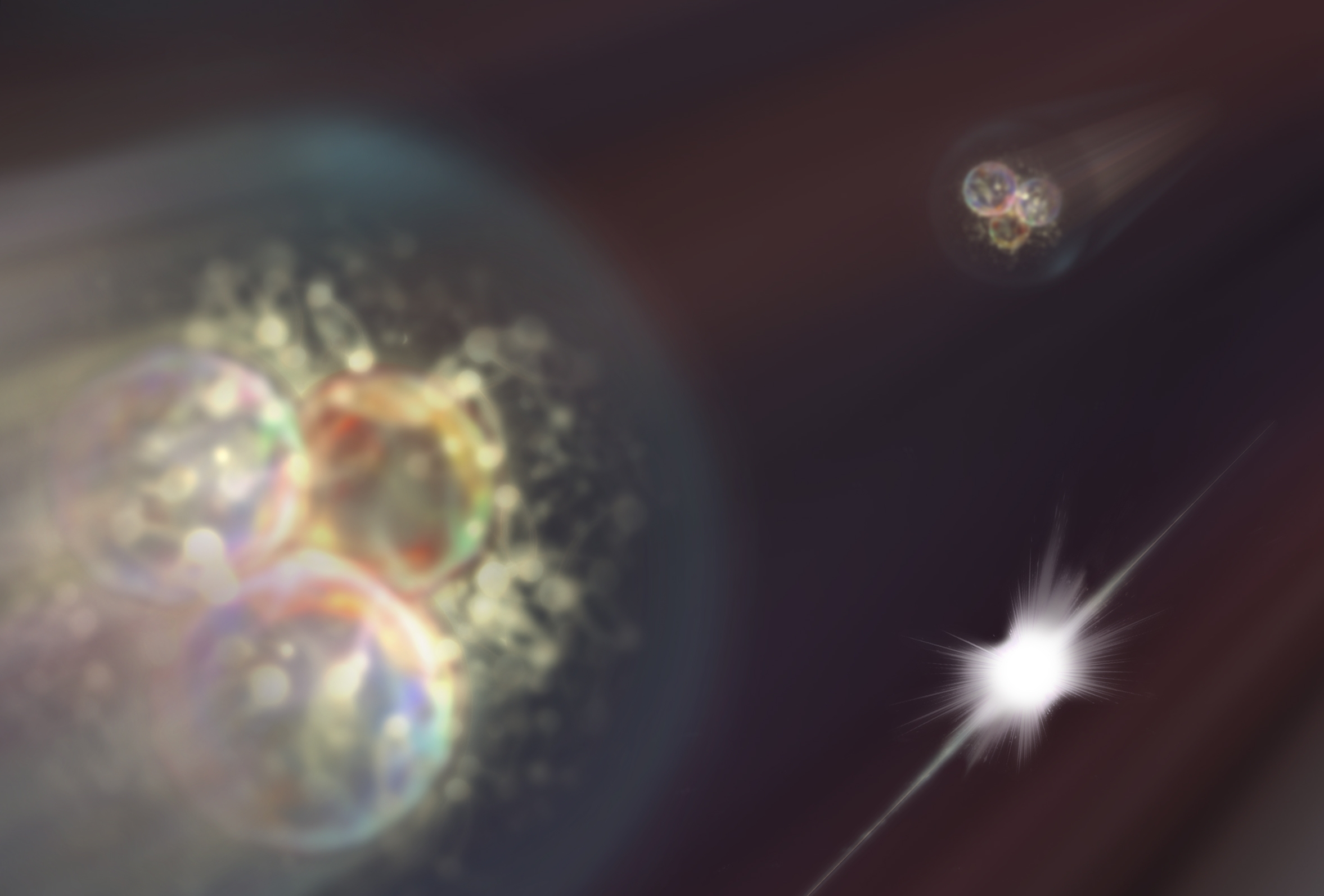
When two high-energy protons from the counter-circulating beams of the LHC collide, the entropy of the interacting quarks and gluons is virtually identical to the entropy of the hadrons that subsequently stream away from the collision point. (Source: IFJ PAN)
Boiling sea of quarks and gluons, including virtual ones – this is how we can imagine the main phase of high-energy proton collisions. It would seem that particles here have significantly more opportunities to evolve than when less numerous and much ‘better-behaved’ secondary particles spread out from the collision point. However, data from the LHC accelerator prove that reality works differently, in a manner that is better described by an improved model of proton collisions.
A lot happens during high-energy proton-proton collisions. Protons are hadrons, i.e. clusters of partons – quarks and the gluons that bind them together. When protons collide with each other at sufficiently high energies, their quarks and gluons (including the virtual ones, which appear momentarily during interactions) enter into various complex interactions. Only when they ‘cool down’ do the quarks stick together to form new hadrons, which scatter from the collision area and are recorded in detectors. Intuition therefore suggests that the entropy of the produced hadrons – a quantity describing the number of states in which the particle system can find itself – should be different from that in the parton phase of the collision, when there are many interacting quarks and gluons, and the interactions appear at first glance to be as chaotic as they are dynamic.
The results of the latest research on hadron and parton entropy in proton collisions are presented in Physical Review D by Prof. Krzysztof Kutak and Dr. Sandor Lokos, scientists from the Institute of Nuclear Physics of the Polish Academy of Sciences (IFJ PAN) in Cracow.
„In high-energy physics, so-called dipole models have been used for some time to describe the
evolution of dense gluon systems. These models assume that each gluon can be represented by
a quark-antiquark pair that forms a dipole of two colours – here we are not talking about ordinary
colours, but the colour charge that is a quantum property of gluons. Dipole models based on the
average number of hadrons produced in a collision allow us to estimate the entropy of partons,
” explains
Prof. Kutak, who has been researching the entropy of complex quark-gluon systems for over
a decade.
Two years ago, Prof. Kutak, in collaboration with Dr. Pawel Caputa from Stockholm University, developed an interesting variation of the dipole model. The scientists treated one of the existing models of gluon system evolution as the leading one and expanded it with subleading effects, important for collisions occurring at lower energies, where the number of hadrons produced in collisions is smaller. This progress was made possible by recognising the connection between the equations of current dipole models and the equations used in complexity theory.
In order to test the validity of the generalised dipole model, Dr. Lokos proposed using the results of measurements collected in various experiments at the LHC accelerator, including four main ones: ALICE, ATLAS, CMS and LHCb. The data covered collisions in a relatively wide energy range, from 0.2 teraelectronvolts up to 13 TeV, which is the maximum energy to which protons can be accelerated in the LHC.
„In our article, we show that the generalised dipole model describes the existing data more accurately
than previous dipole models and, moreover, works well in a wider range of proton collision
energies,
” underlines Prof. Kutak.
So, in proton collisions, does the entropy in the phase dominated by quark and gluon interactions differ from the entropy of the produced hadrons escaping from the collision site? The existing Kharzeev- Levin formula for entropy hypothesises that it does not, which has been confirmed in the work of Prof. Kutak and his colleagues. This assumption and the results just obtained elicit surprise on the faces of some physicists and a mysterious smile on others. On the one hand, they seem counterintuitive at first glance, but on the other, they are in fact a consequence of one of the most fundamental features of quantum mechanics: its unitarity.
Unitarity may sound intimidating, but in reality it is a fairly intuitive requirement. The point is that the equations describing the evolution of a quantum system, its possible transitions from an earlier state to a later one, should preserve the sum of the probabilities of all transitions (equal to one) and be reversible. In other words, unitarity means that neither probability nor information can be lost or created out of nowhere.
„The unitarity of quantum mechanics is something that physics students learn about. The formalism
of quantum chromodynamics, the theory describing the world of quarks and gluons, is based
on unitarity. However, it is one thing to deal with a theory that exhibits a certain feature at the level
of quarks and gluons on a daily basis, and quite another to observe it in real data on produced
hadrons,
” notes Prof. Kutak, emphasising that it is thanks to unitarity that the result obtained allows
us to obtain information about the entropy of partons in a wide range of energies.
Further verification of the generalised dipole model will be possible at the beginning of the next decade, after the completion of the LHC accelerator upgrade. The improved ALICE detector will then allow measurements to be taken of gluon interaction areas that are denser than those currently being studied. Data from the Electron–Ion Collider (EIC) accelerator, currently under construction at Brookhaven National Laboratory in the USA, where electrons will be collided with protons, will also be particularly valuable. Since electrons are elementary particles, this configuration will allow the study of dense gluon systems in single protons.
[PDF]
Contact:
Prof. dr hab. Krzysztof Kutak
Institute of Nuclear Physics, Polish Academy of Sciences
tel.: +48 12 662 8312
email: krzysztof.kutak@ifj.edu.pl
Scientific papers:
„Entropy and multiplicity of hadrons in the high energy limit within dipole cascade models”
K. Kutak, S. Lökös
Physical Review D 112, 096017, 2025
DOI: 10.1103/23wn-66np
Images:
When two high-energy protons from the counter-circulating beams of the LHC collide, the entropy of the interacting quarks and gluons is virtually identical to the entropy of the hadrons that subsequently stream away from the collision point. (Source: IFJ PAN)